Cost reference
Washer repair cost
Washer repair is unusually predictable at the low end and unusually brutal at the top. Pumps, switches, belts and valves are cheap parts fitted in under an hour. Tub bearings are a strip-down that regularly costs more than the machine is worth. Almost every washer decision comes down to which side of that line the fault sits on.
- Typical repair
- $150–$350
- Diagnostic fee
- $50–$100
- New unit
- $800
- Expected life
- 11 yr
- Pros listed
- 673
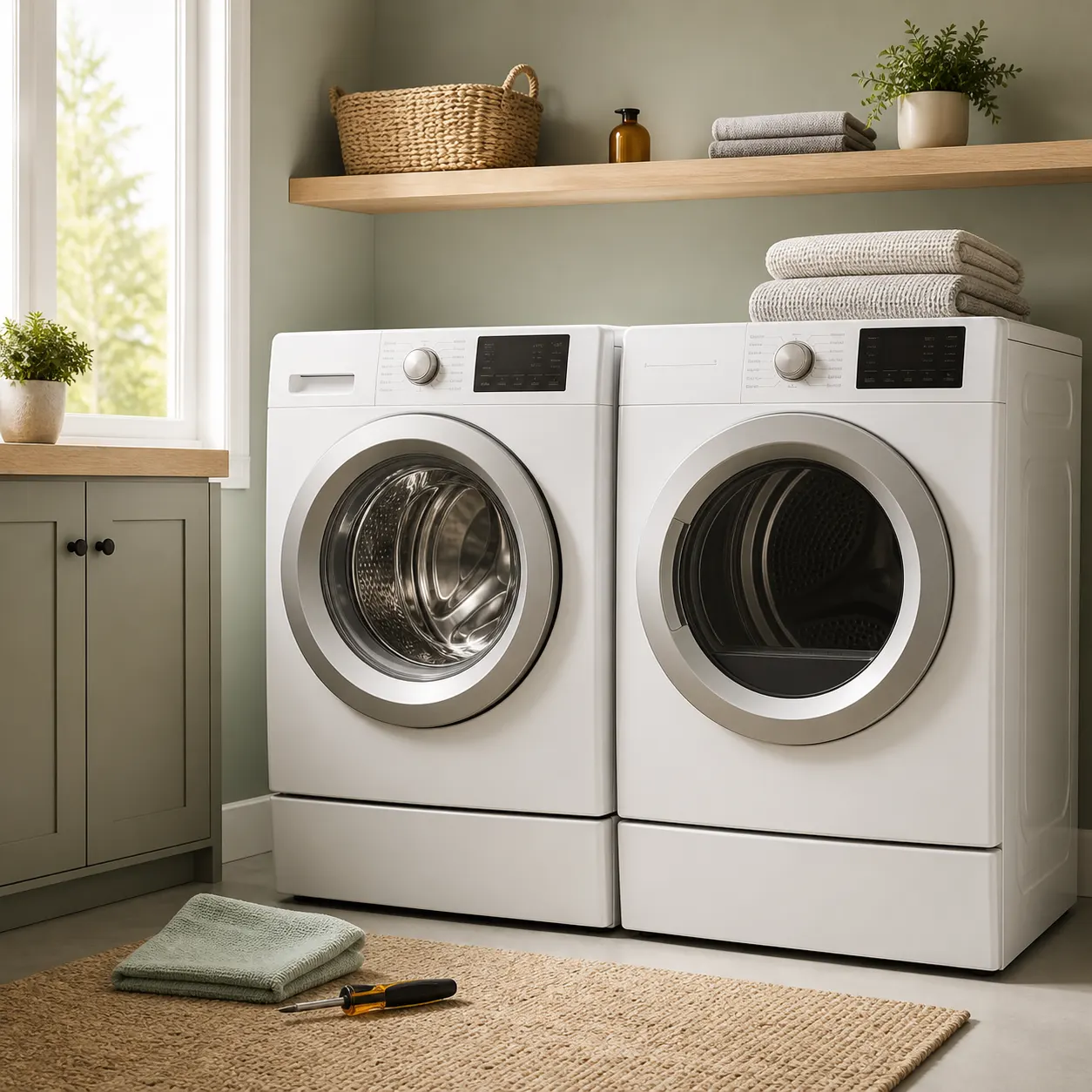
How much does washer repair cost?
Most washer repairs land between $150–$350 for parts and labour together, on top of a $50–$100 diagnostic fee that many shops credit against the repair if you approve the work the same day.
Lid switches, door locks, drive belts, couplers, drain pumps and inlet valves fill the bottom two-thirds of the band. The top is tub bearings and the door boot on a front-loader — the two jobs where the machine has to come substantially apart.
- Cheapest priced job
- $80–$160
- Dearest priced job
- $400–$700
- Replace above
- $400
Cheapest priced job: Clear pump filter or drain blockage. Dearest: Tub bearings. These are typical national ranges for the job, not quotes. Local rates vary and a written estimate for your own appliance is the only figure that binds anyone.
Washer repair cost by job
8 named washer jobs, each priced as a typical range covering parts and labour on a mainstream freestanding unit. These run roughly in the order a technician works through them, which is why clear pump filter or drain blockage leads rather than the cheapest line.
| Job | Typical cost | What moves the number |
|---|---|---|
| Clear pump filter or drain blockage | $80–$160 | Frequently just the diagnostic fee. |
| Lid switch or door lock assembly | $130–$250 | The cheapest genuine part failure on a washer. |
| Drive belt or motor coupler | $150–$300 | Coupler on a direct-drive top-loader is a designed sacrificial part. |
| Drain pump replacement | $150–$350 | Check for a lodged coin first — pumps are often blamed unfairly. |
| Door boot seal (front-loader) | $200–$400 | Replace, do not patch; a mended boot leaks again. |
| Suspension rods or shock absorbers | $180–$400 | Always replaced as a set of four. |
| Water inlet valve | $150–$300 | Clean the inlet screens before condemning the valve. |
| Tub bearings | $400–$700 | On most mid-market machines this exceeds the replace threshold. |
Ranges cover parts and labour on a mainstream washer in a standard installation. A built-in, stacked or luxury unit sits above them, sometimes well above, because the access time and the parts channel are both different — a $800 mainstream replacement and a luxury equivalent do not have the same repair economics. Where a job is licensed work — gas, sealed refrigeration systems, or fixed wiring — the range assumes a correctly certified technician, because there is no legal cheaper version of it.
What drives the price on a washer
Two households with the identical washer fault can be quoted very differently, and the reasons are specific to this appliance rather than generic. These three account for most of the spread.
- Top-loader or front-loader
- They fail differently and they cost differently. A direct-drive top-loader has a sacrificial motor coupler that is cheap to replace by design. A front-loader has a door boot, a door lock and a bearing set, and all three are more involved. The same symptom on the two machines is not the same quote.
- Whether it is stacked or in a closet
- A stacked pair has to be unstacked, and a laundry-closet installation has to be pulled out into the hallway before the back comes off. Neither is difficult and both are time, billed at the same rate as the repair.
- What caused it
- A drain pump killed by a coin is a pump. A drain pump killed because the machine has been run overloaded for years is a pump today and a bearing next year. Technicians price what they can see; the second visit is the one that decides whether the machine was worth the first.
The cheap fix mistaken for an expensive one
The lid switch or door lock. A washer that fills and then does nothing looks like a dead motor or a failed control board, and both of those are quoted far higher. On most machines the control simply will not run a cycle it cannot confirm is safe, and the switch that confirms it is among the cheapest parts in the cabinet.
Where the labour actually goes
Washers are the appliance where the part-to-labour ratio is most lopsided at the cheap end. A drain pump or an inlet valve costs a fraction of the quoted job; almost all of the rest is the trip, the diagnosis and the hour. That is the honest reason to ask what the part costs as a separate line — not because the labour is unfair, but because knowing the split tells you whether a second quote is worth another call-out fee.
DIY versus pro, fault by fault
The same 15 washer faults priced both ways. The DIY column is the part, assuming you diagnosed it correctly. The pro column includes the trip, the diagnosis, the hour and a warranty on the work.
| Fault | Job | DIY parts | Quoted pro |
|---|---|---|---|
| Washer Won't Drain | moderate45–90 minutes | $0–$130 | $150–$400 |
| Washer Won't Spin | moderate30–90 minutes | $0–$120 | $150–$600 |
| Washer Leaking Water | moderate30–90 minutes | $15–$150 | $150–$600 |
| Washer Smells Musty | easy45–90 minutes plus a cleaning cycle | $10–$25 | $120–$250 |
| Washer Shaking and Walking | moderate30–90 minutes | $0–$120 | $150–$600 |
| Washer Won't Start | easy15–45 minutes | $0–$110 | $120–$400 |
| Washer Won't Fill With Water | easy20–60 minutes | $5–$85 | $130–$350 |
| Front-Load Washer Door Won't Open | moderate20–60 minutes | $0–$140 | $140–$350 |
| Washer Cycle Taking Far Too Long | easy45–90 minutes plus a test cycle | $0–$95 | $150–$350 |
| Washer Won't Agitate | moderate45–120 minutes | $8–$60 | $150–$450 |
| Washer Overfilling or Won't Stop Filling | moderate30–90 minutes | $10–$90 | $150–$400 |
| Washer Dispenser Not Emptying | easy30–60 minutes | $0–$60 | $130–$320 |
| White Residue or Grey Marks on Washed Clothes | easy45–90 minutes plus a cleaning cycle | $0–$40 | $130–$300 |
| Washer Not Filling With Hot Water | moderate30–75 minutes | $0–$90 | $150–$350 |
| Top-Load Washer Lid Won't Unlock | moderate20–75 minutes | $0–$110 | $150–$350 |
How far a homeowner can take this
Clearing the pump filter, checking for a lodged coin, levelling the machine, removing shipping bolts and replacing inlet hoses are all safely within reach and fix a real share of no-drain and walking-machine calls. The line is the outer tub. On most modern front-loaders it is sealed and the bearing is not serviceable separately, which turns a cheap part into a machine-sized job.
What the DIY column does not include
Your time, the tools, and the cost of being wrong. Buying the correct part needs the model number off the tag on the washer, and a part fitted for a fault that was something else is money gone — most suppliers will not take back an electrical part once it has been installed. 1 of the 9 parts below needs nothing more than a screwdriver, but knowing which one to buy is the hard half. If you are not confident in the diagnosis, the $50–$100 diagnostic fee is the cheaper purchase.
What the parts cost on their own
9 washer parts at typical retail for the part alone — no labour, no shipping, no diagnosis. 1 of them is rated easy to fit. This is the number to hold a washer quote against.
| Part | Typical retail | Install | Lifespan |
|---|---|---|---|
| Drain Pump | $30–$80 | moderate | 8–12 years |
| Lid Switch | $15–$40 | easy | 5–10 years |
| Door Lock Assembly | $40–$140 | moderate | 6–10 years |
| Drive Belt | $15–$50 | moderate | 8–12 years |
| Water Inlet Valve | $25–$85 | moderate | 8–12 years |
| Shock Absorbers and Suspension Rods | $30–$100 | moderate | 8–12 years |
| Motor Coupler | $15–$45 | moderate | 6–12 years |
| Door Boot Seal | $60–$190 | advanced | 8–12 years |
| Tub Bearing Kit | $35–$160 | advanced | 10–14 years |
Every washer part priced here falls between $15–$190 for the component alone. Set that against the 8 job ranges above and the difference is the trip, the diagnosis and the access. Knowing the split does not make a washer quote wrong — it tells you whether a second opinion is worth paying the $50–$100 diagnostic fee twice.
When replacing the washer wins
The arithmetic first — a $800 appliance with a 11-year life — then the cases where the arithmetic is not the whole answer.
New unit
$800
Typical price for a mainstream washer. A budget brand runs below it, a premium or built-in model well above.
Replace above
$400
Half the price of a new washer. A quote above this usually means replacement is the better spend — that is 0 of the 8 jobs listed above.
Expected life
11 yr
10–13 years. Top-loaders with a mechanical transmission often outlast that; high-speed front-loaders trend lower because their bearings and boot seals carry more work per cycle.
Cost per year new
$73
New price spread over expected life. If a repair buys more years than it costs at this rate, the repair is winning.
Replace a washer when
- The quote is for tub bearings or a transmission on a machine past year eight.
- The repair is over half the price of a comparable new machine.
- The drum has cracked, or the outer tub is welded shut and the failed part is inside it.
- It is the third repair in two years — the remaining components are all the same age.
The cost read on this appliance
Tub bearings are the standard replace trigger on a washer, and on most mid-market machines the quote alone exceeds half the price of a new one. The tell is a rising jet-engine roar on spin. If you hear it on a machine past year eight, get the bearing quote and price a replacement in the same afternoon — the two numbers usually answer the question between them.
If the repair quote is more than half the price of an equivalent new unit, replacement is usually the better spend. Below half, repair almost always wins on cost per remaining year of service. Then check the age against expected lifespan. An appliance past roughly three-quarters of its expected life has little runway left to earn back a large repair, so the threshold drops as the machine gets older — on an old unit, a repair at a third of new price can still be the wrong call.
Early failures skew this. Chronic overloading is the usual cause of a machine dying at year six. It loads the bearings, wears the suspension and leaves detergent that never rinses clear. Machines installed on a springy upper-floor deck without a solid base fail early for the same reason.
Value my washerBefore you call for a washer quote
A washer quote is only as good as the information behind it, and 673 businesses here list this appliance. Have these ready and the first visit is far more likely to be the only visit.
The one question worth answering first
Does the drum turn freely by hand with the machine off, and does it sound rough when you spin it? A drum that turns silently and freely points at a belt, coupler or control fault — the cheap end. A drum that grinds or rumbles when you spin it by hand points at bearings, and that changes the entire economics of the call.
- Top-loader or front-loader, and the model number from the door rim or the back panel.
- The exact error code, if the display shows one.
- Whether the drum spins freely by hand when the machine is off.
- Whether water is left standing in the drum at the end of the cycle.
- Whether the noise happens on wash, on spin, or on both.
Then ask every shop the same four questions: what is the diagnostic fee, is it credited if I approve the repair today, do you carry parts for this brand, and how long is the warranty on the work. Those four answers explain most of the spread between quotes, and none of them require the technician to have seen the appliance.
Washer repair cost questions
How much does washer repair cost?
Is it worth repairing a washer?
What is the cheapest thing that goes wrong with a washer?
How much of a washer repair bill is labour?
Can I repair a washer myself and save the labour?
What should I have ready before calling for a washer repair quote?
Compare against other appliances
Same figures, every appliance type. The typical band is where most repairs land; the replace threshold is half the price of a new unit.
| Appliance | Typical repair | Diagnostic | Replace above |
|---|---|---|---|
| Refrigerator | $200–$400 | $50–$120 | $600 |
| Washer | $150–$350 | $50–$100 | $400 |
| Dryer | $100–$350 | $50–$100 | $375 |
| Dishwasher | $150–$300 | $50–$100 | $350 |
| Oven & Range | $150–$450 | $50–$120 | $500 |
| Microwave | $100–$250 | $40–$80 | $125 |
| Garbage Disposal | $85–$250 | $40–$90 | $100 |
| Ice Maker | $150–$400 | $50–$100 | $200 |
| Freezer | $150–$400 | $50–$120 | $300 |
| Wine Cooler | $200–$600 | $60–$130 | $250 |
| Range Hood | $150–$400 | $50–$100 | $175 |
| Trash Compactor | $150–$450 | $50–$110 | $400 |